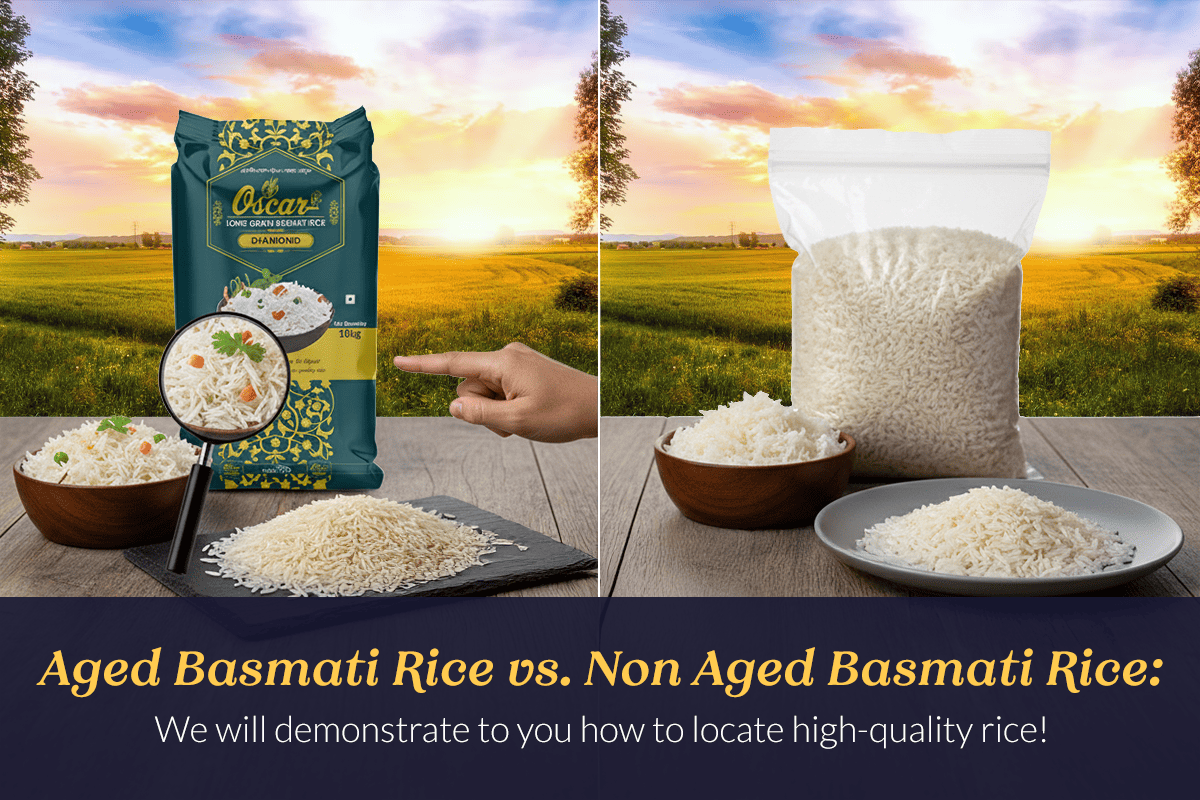
Aged Basmati Rice vs. Non-Aged Basmati Rice: We will demonstrate to you how to locate premium basmati rice!
We are always posed with this question: why is it such a big deal about aged basmati rice? Why is it that the quality and even the price of the basmati rice are affected simply because of some time? We are the proud parent company of Oscar Basmati Rice, and we are going to tell you the secrets of our decades of experience. You can count on us; once you know what you are looking at, you will never be satisfied with anything less than premium quality basmati rice!
The secret lies in the aging process
When any kind of rice first gets introduced, it is a non-aged basmati rice. It inherently contains greater moisture composition. When you cook fresh rice, it is not as hard, it is a bit sticky, and the grains are not as pretty to separate. This is why rare connoisseurs and the best chefs are in pursuit of aged basmati rice.
Aging is a delicate, natural practice during which the raw rice is kept under certain controlled conditions, usually between 12 and 24 months. During this period, the rice dries, the starches become crystallized, and the natural aromatic compounds increase. This is what makes good rice become premium quality basmati rice.
What to Look at to Discover Premium Aged Basmati Rice
One does not have to be a food scientist to notice the difference between aged basmati rice and non-aged basmati rice. The following three are the main indicators that we consider, particularly in such varieties of rice as 1121 basmati rice:
- Examine the Color: Non–aged basmati rice is the most common and is very bright, pearly white. Real, well-aged basmati rice will most likely assume a slight tinge of creamy white to a slight tint of yellowish gold. Such a slight shift of color is a characteristic warning of the lower moisture level and successful aging.
- Check the Grain: Before cooking, check out the dry grains. Premium basmati rice must contain additional long grain basmati rice, which is slender and even, undamaged, with only little cracking. The grains are made stronger by the aging process; thus, they cannot easily break during the milling and cooking process.
Cooking Test (The Ultimate Clue!): It is here that long grain basmati rice really excels
- Fluffiness and Separation: When aged basmati rice gets cooked, it becomes very light and fluffy and does not stick. All the grains must be individual and independent—ideal in biryanis or pilafs.
- Elongation: Rice of good quality will increase in size to nearly twice its size when it is cooked. This is a dramatic length of the finest basmati rice in India.
When you take a bag of Oscar basmati chawal, be it the 5 kg or the bigger 10 kg size, we have done the hard work to assure you of meeting these standards. We guarantee that nutty aroma and that fluffiness each and every time. Do not sacrifice your cooking; never buy rice that promises to grow and to be of quality!